
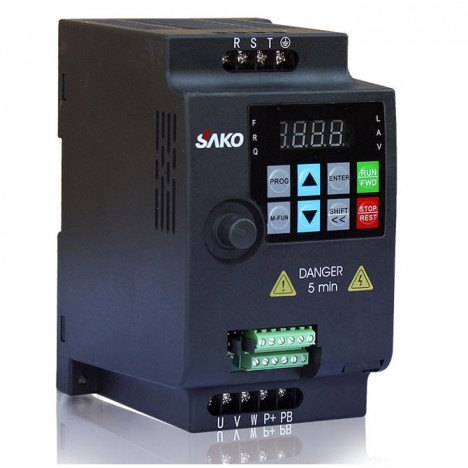
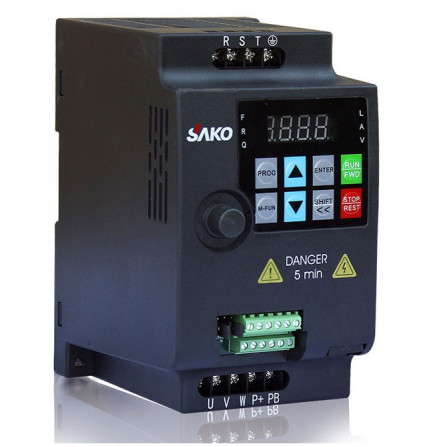
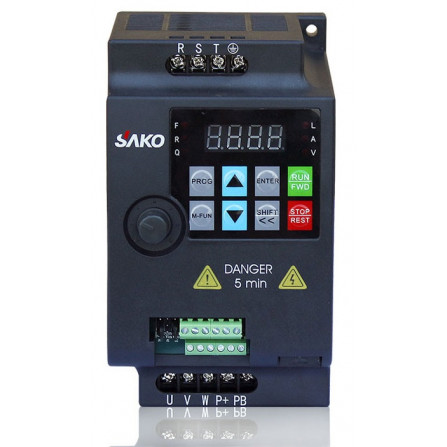
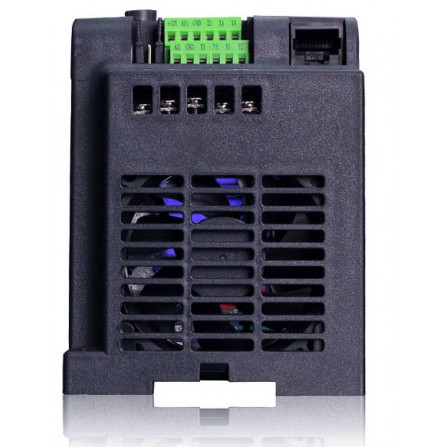
Model SKI780-2D2G-4
Power – 2.2 kW
Output current – 5.1 A
Supply – Three-phase (3PH) 380V ± 15%, 5.8A, 47Hz-63Hz
Output voltage - Three-phase (3PH) 0V-380V
Output frequency - 0Hz-400Hz
Mounting dimensions – 81 x 61 mm
Overall dimensions – 200 x 140 x 160 mm
Weight – 1 kg
The VFD (Variable Frequency Drive) inverter is a device that regulates the rotational speed of an electric motor by changing the frequency and supply voltage. It is widely used in industry for controlling asynchronous electric motors.
Key features and advantages:
1. Speed Control: Allows you to smoothly adjust the motor speed, which is beneficial for various technological processes.
2. Energy Savings: Optimises energy consumption, reducing energy costs.
3. Motor Protection: Built-in protection functions against overload, overheating, overvoltage, and short circuits extend the motor's lifespan.
4. Improved Performance: Stable control of motor speed and torque improves the efficiency of production processes.
5. Reduced Wear: Smooth starting and stopping of the motor reduces mechanical wear and extends equipment life.
6. Easy to Install and Operate: Features an intuitive interface and can be easily integrated into existing automation systems.
Operating Principle:
The VFD inverter converts the input AC voltage to DC voltage using a rectifier. The DC voltage is then converted back to AC with variable frequency and amplitude using an inverter. This process allows the frequency and voltage supplied to the motor to be precisely controlled, thereby regulating its speed.
Inverter Components:
1. Rectifier : Converts input AC voltage to DC voltage.
2. Intermediate Circuit : Smooths and stabilises the DC voltage.
3. Inverter : Converts DC voltage back to AC voltage at a controlled frequency.
4. Controller : Manages all conversion and adjustment processes, ensuring precise motor control.
VFD inverters are a key component of modern control systems, providing flexibility and efficiency in various applications.
Model SKI780-2D2G-4
Power – 2.2 kW
Output current – 5.1 A
Supply – Three-phase (3PH) 380V ± 15%, 5.8A, 47Hz-63Hz
Output voltage - Three-phase (3PH) 0V-380V
Output frequency - 0Hz-400Hz
Mounting dimensions – 81 x 61 mm
Overall dimensions – 200 x 140 x 160 mm
Weight – 1 kg