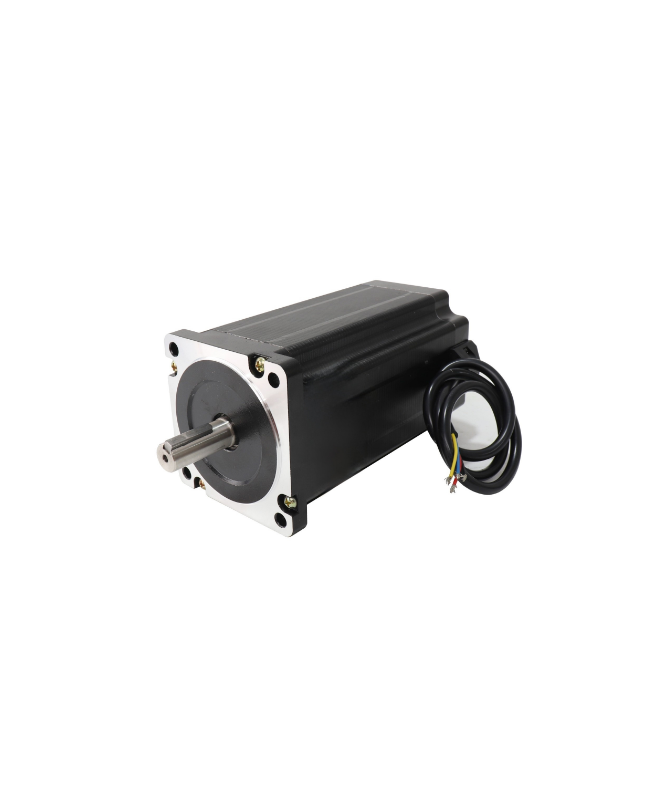
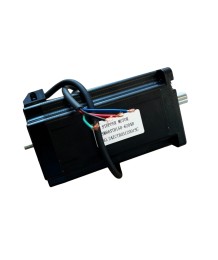
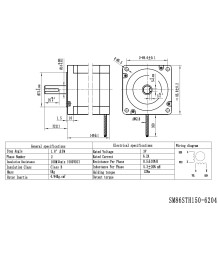
Model - SM86STH150-6204
Frame - Nema 34
Step angle - 1.8° ± 5%
Number of phases – 2
Rated voltage – 3 V
Rated current – 6.2 A
Phase resistance – 0.5 ± 10% Ω
Phase inductance – 5.3 ± 20% mH
Holding torque – 12 Nm
Length - 149 ± 1 mm
Front shaft diameter - Ø14
Rear shaft diameter - Ø5
Weight – 5.000 kg
A stepper motor is an electric motor that converts electrical pulses into discrete mechanical movements. This means that it moves in specific steps, with each electrical pulse corresponding to one step.
Key Features:
- Positioning Precision: They offer high positioning accuracy without the need for feedback sensors.
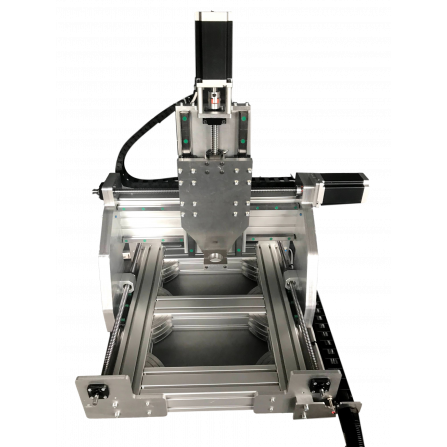
- Controlled Movement: Stepper motors allow precise control of speed and position without the need for feedback, making them suitable for applications in CNC machines, 3D printers, and robots.
- Stability at Low Speeds: They can operate stably at low speeds, where other types of motors may have issues.
Main Types of Stepper Motors:
- Permanent Magnet: Use permanent magnets to generate a magnetic field, offering good accuracy and easy control.
- Hybrid: Combine elements of permanent magnet and variable reluctance stepper motors to achieve higher precision and efficiency.
- Variable Reluctance: Use ferromagnetic materials and operate by changing magnetic reluctance.
Control and Drivers
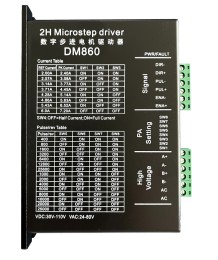
Drivers are required to control stepper motors, which supply the precise pulses to the motor windings. Drivers can be:
- Bipolar: Use two windings and can reverse the current direction in them.
- Unipolar: Use four windings or center taps of two windings and control current in only one direction.
Stepper motors are an important component in many modern technologies, thanks to their precision, reliability, and ease of control.
Model - SM86STH150-6204
Frame - Nema 34
Step angle - 1.8° ± 5%
Number of phases – 2
Rated voltage – 3 V
Rated current – 6.2 A
Phase resistance – 0.5 ± 10% Ω
Phase inductance – 5.3 ± 20% mH
Holding torque – 12 Nm
Length - 149 ± 1 mm
Front shaft diameter - Ø14
Rear shaft diameter - Ø5
Weight – 5.000 kg